
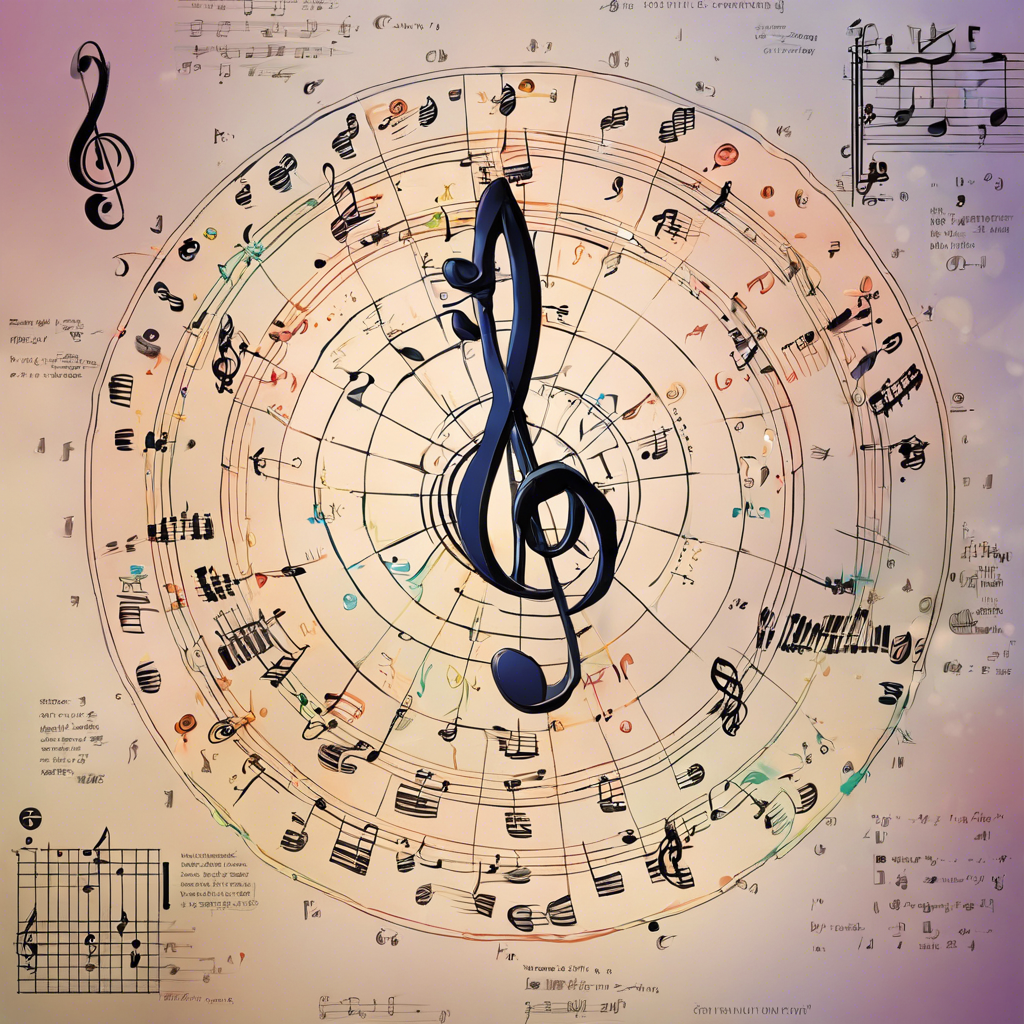
Circle of Fifths: The Backbone of Music Theory
सर्कल ऑफ फिफ्थ्स: संगीत सिद्धांत की रीढ़
The Circle of Fifths is one of the most powerful tools in music theory. It provides a visual representation of the relationship between different keys and helps musicians understand how chords, scales, and key signatures work together. This essential concept is not only useful for composers and instrumentalists but also for anyone looking to deepen their understanding of music.
सर्कल ऑफ फिफ्थ्स एक ऐसा चार्ट है जो संगीत के विभिन्न स्वर और उनके आपसी संबंध को दर्शाता है। यह संगीतकारों और संगीत के विद्यार्थियों के लिए बहुत महत्वपूर्ण उपकरण है।
1. What is the Circle of Fifths? | सर्कल ऑफ फिफ्थ्स क्या है?
The Circle of Fifths is a circular diagram where the 12 notes of the chromatic scale are arranged in a specific order. Each step around the circle represents a perfect fifth interval. Moving clockwise, the keys increase by one sharp, while moving counterclockwise, they increase by one flat.
For example:
- Starting at C major (no sharps or flats), moving clockwise leads to G major (1 sharp), then D major (2 sharps), and so on.
- Moving counterclockwise from C major leads to F major (1 flat), then B♭ major (2 flats), and so forth.
यह चार्ट स्वर और स्केल्स के बीच के संबंध को स्पष्ट रूप से समझाने का काम करता है।
2. Structure of the Circle of Fifths | सर्कल ऑफ फिफ्थ्स की संरचना
The Circle of Fifths is divided into major keys and their relative minor keys:
a. Major Keys | मेजर स्केल्स
Major keys are located on the outer circle. Each key has a specific number of sharps or flats in its key signature.
b. Minor Keys | माइनर स्केल्स
Minor keys are located on the inner circle. They share the same key signature as their relative major key. For example, A minor is the relative minor of C major.
इस चार्ट में मेजर और माइनर स्केल्स को उनके आपसी संबंधों के साथ दिखाया गया है।
3. Applications of the Circle of Fifths | सर्कल ऑफ फिफ्थ्स के उपयोग
a. Key Signature Identification | की सिग्नेचर पहचान
The Circle of Fifths helps musicians quickly identify the key signature of any piece of music.
- Moving clockwise shows the addition of sharps.
- Moving counterclockwise shows the addition of flats.
b. Modulation | स्वर परिवर्तन
The Circle is a valuable tool for modulation, which is the process of changing from one key to another. Keys adjacent on the circle share common notes, making transitions smoother.
उदाहरण के लिए, C मेजर से G मेजर में परिवर्तन करना आसान होता है क्योंकि दोनों स्केल्स में अधिकांश स्वर समान होते हैं।
c. Chord Progressions | कॉर्ड प्रोग्रेशन
The Circle of Fifths is often used to create pleasing chord progressions, such as the popular I-IV-V-I progression.
d. Improvisation and Composition | सुधार और रचना
For composers and improvisers, the Circle of Fifths provides a roadmap for creating harmonious melodies and accompaniments.
4. How to Use the Circle of Fifths | सर्कल ऑफ फिफ्थ्स का उपयोग कैसे करें
Step 1: Understand the Relationship Between Keys | स्वरों के बीच संबंध को समझें
Identify the major key you’re working with and its relative minor. Use this as your starting point.
Step 2: Explore Adjacent Keys | पास के स्वरों का अन्वेषण करें
Keys next to each other on the circle are closely related and can be used for smooth transitions in compositions.
पास के स्वरों का उपयोग स्वर परिवर्तन और कॉर्ड प्रोग्रेशन के लिए सबसे अधिक किया जाता है।
Step 3: Build Chord Progressions | कॉर्ड प्रोग्रेशन बनाएं
Using the Circle, experiment with chord progressions like:
- I-IV-V-I (e.g., C-F-G-C)
- ii-V-I (e.g., Dm-G-C in C major)
Step 4: Use for Modulation | मॉड्यूलेशन के लिए उपयोग करें
To modulate, pick a new key from the circle and gradually introduce chords from that key.
5. Sharps and Flats in the Circle of Fifths | सर्कल ऑफ फिफ्थ्स में शार्प्स और फ्लैट्स
The Circle helps in remembering the order of sharps (F#, C#, G#, D#, A#, E#, B#) and flats (B♭, E♭, A♭, D♭, G♭, C♭, F♭) in key signatures.
Sharps Example | शार्प्स का उदाहरण
- G major has 1 sharp (F#).
- D major has 2 sharps (F#, C#).
Flats Example | फ्लैट्स का उदाहरण
- F major has 1 flat (B♭).
- B♭ major has 2 flats (B♭, E♭).
यह पद्धति स्वर और की सिग्नेचर को याद रखने के लिए बहुत उपयोगी है।
6. Advanced Concepts | उन्नत अवधारणाएँ
a. Enharmonic Equivalents | एनहार्मोनिक समतुल्य
Some keys, like B major (5 sharps) and C♭ major (7 flats), sound the same but are written differently.
b. Diminished Fifths and Augmented Fourths | डिमिनिश्ड फिफ्थ और ऑगमेंटेड फोर्थ
The Circle can also be used to explore tritone intervals, which are halfway across the circle.
c. Modes and Scales | मोड्स और स्केल्स
The Circle of Fifths is useful for exploring modes like Dorian, Phrygian, and Mixolydian, which are derived from major and minor scales.
7. Challenges in Using the Circle of Fifths | सर्कल ऑफ फिफ्थ्स का उपयोग करने में चुनौतियाँ
- Memorization: Beginners may find it difficult to memorize the order of sharps and flats.
- Application: Knowing the Circle conceptually is different from applying it effectively in real-time music situations.
शुरुआत में इसे समझना कठिन हो सकता है, लेकिन अभ्यास इसे आसान बना देता है।
8. Tips for Mastery | सर्कल ऑफ फिफ्थ्स में महारत के लिए सुझाव
- Practice Regularly: Use the Circle when composing or analyzing music.
- Visual Aids: Keep a printed version of the Circle for reference.
- Experiment: Try creating different progressions using adjacent and distant keys.
- Learn Relative Keys: Memorize major and minor pairs for quick transitions.
Conclusion | निष्कर्ष
The Circle of Fifths is a cornerstone of music theory that simplifies key signatures, chord progressions, and modulation. By mastering this tool, musicians unlock a deeper understanding of harmony and composition.
“Music is the universal language, and the Circle of Fifths is its grammar.”“संगीत एक वैश्विक भाषा है, और सर्कल ऑफ फिफ्थ्स उसका व्याकरण है।”